
Manchester Cathedral aims to provide a first-class experience to all visitors and worshippers alike, continuously looking to improve accessibility and facilities for all. Below is some information you may find useful ahead of your visit to us.

Bicycles can be chained to the railings adjacent to the Cathedral Cafe, out of the Cathedral's south door, at visitors' own risk.

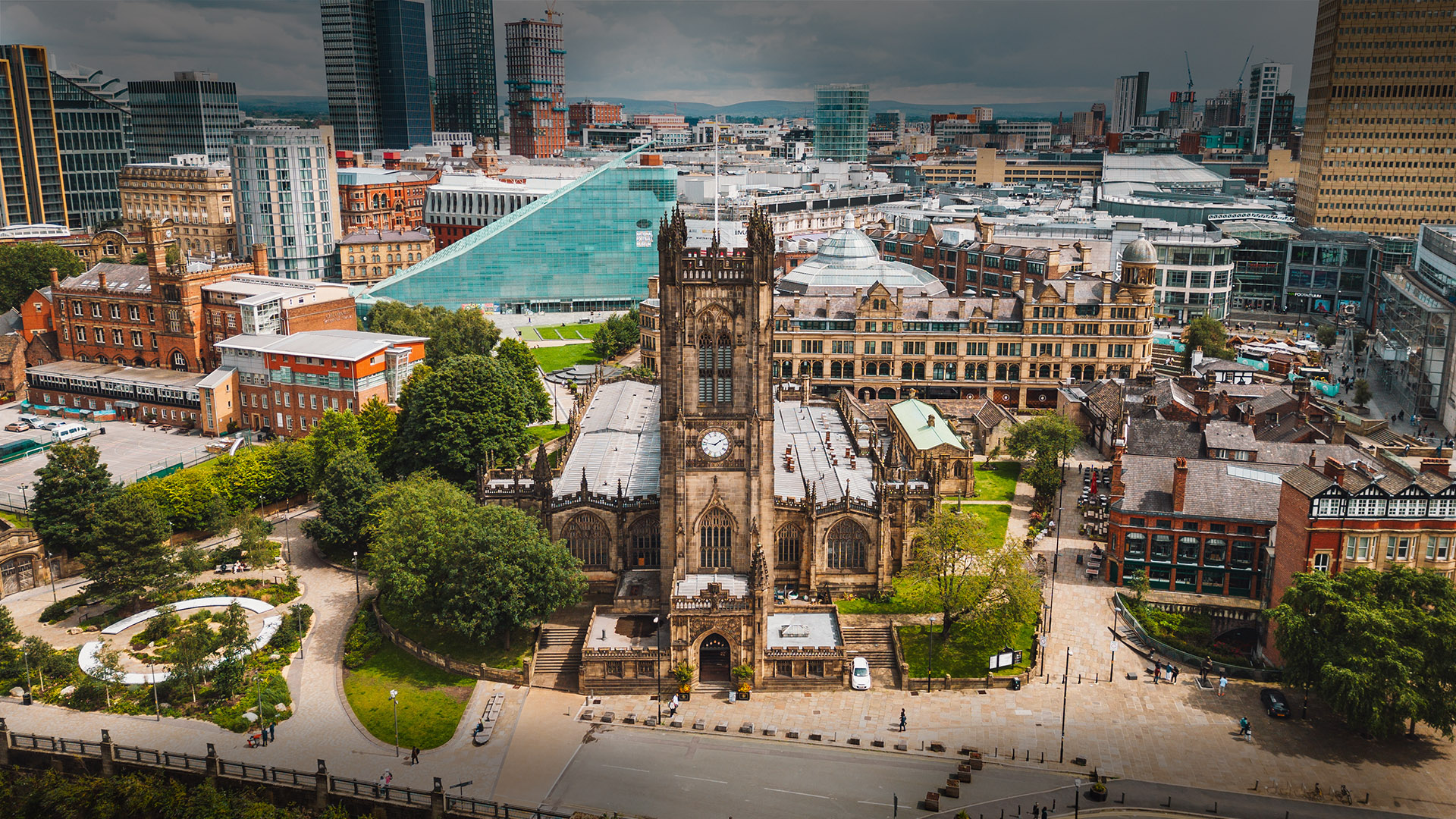
The nearest train station is Manchester Victoria which is 5-minute walk away.

The nearest tram stops are Victoria and Exchange Square. Both are a 5-minute walk away.

To plan your bus journey to Manchester Cathedral head to tfgm.com
We are open for general visiting as follows:
These times may vary during special events. During the set up for services and events, access may be limited to the east end only.
Visiting the Cathedral is free. There is a suggested donation of £5 to help support the running costs of the Cathedral. Contactless donations are accepted.
There are free guided tours generally available for individuals and families from Monday to Saturday between 10am and 4pm (subject to volunteer availability). For larger groups wishing to book a chargeable tour please contact us by email.
We have a wonderful team of volunteers on hand to answer any queries and to help you make the most of your visit. If you would rather wander around at your leisure, we have a comprehensive guide leaflet that helps ensure that you do not miss any of the highlights.
Whilst we do try to ensure everyone can enjoy all that Manchester Cathedral has to offer, we are a Grade One listed medieval building and acknowledge that it is not always possible to provide all of the facilities that we would like.
We hope our accessibility guide will answer any questions that you may have and help to make your visit more enjoyable.
Manchester Cathedral host a wide range of concerts and events. While the set up of each individual event is in the hands of those who have hired our spaces, often event organisers will provide designated areas for visitors with additional needs to enjoy their events safely.
Please email our events team in good time stating which event you will be attending and your access needs, and they can pass your details on to the relevant external organiser.
The Cathedral has a hearing-loop for those attending our regular services and events in person. Please set your hearing aid to setting T.
Large print versions of our service sheets and visitor welcome leaflet are available. Please ask a welcomer or guide for more information when you visit Manchester Cathedral.
We are planning to install public toilets inside the Cathedral, but at present we do not have visitor toilets inside Manchester Cathedral.
The nearest other public toilets, including accessible toilets, are available in Marks and Spencer and The Arndale shopping centre. Both are roughly a 5-minute walk away.
Please do not hesitate to contact us should you have any unanswered questions ahead of your visit.
Please be aware that with the exception of August, bell ringing practice takes place at the Cathedral on a Wednesday evening every week from 7pm to 9pm.
Here at Manchester Cathedral, your safety is our priority. If you are planning a visit, please take a moment to familiarise yourself with the security information below.
All of our staff play a vital role in keeping visitors safe and are always on hand should you need to report anything. We use a range of security features—some of which are visible, others less so.
We maintain strong communication with neighbouring businesses to share safety information and work closely with a range of partners, including Greater Manchester Police, to ensure your visit to Manchester Cathedral is both safe and enjoyable.
You can help keep everyone safe by reporting anything that doesn’t feel right. Don’t hesitate to speak up—no matter how minor it may seem. Trust your instincts, and we’ll take care of the rest.
For further information, please follow the link to the ACT campaign website –
Trust Your Instincts and Report | Action Counters Terrorism
We are delighted to offer bookable tours for school groups, to share the incredible stories our Grade I listed building holds and to enrich your schools’ curriculum.
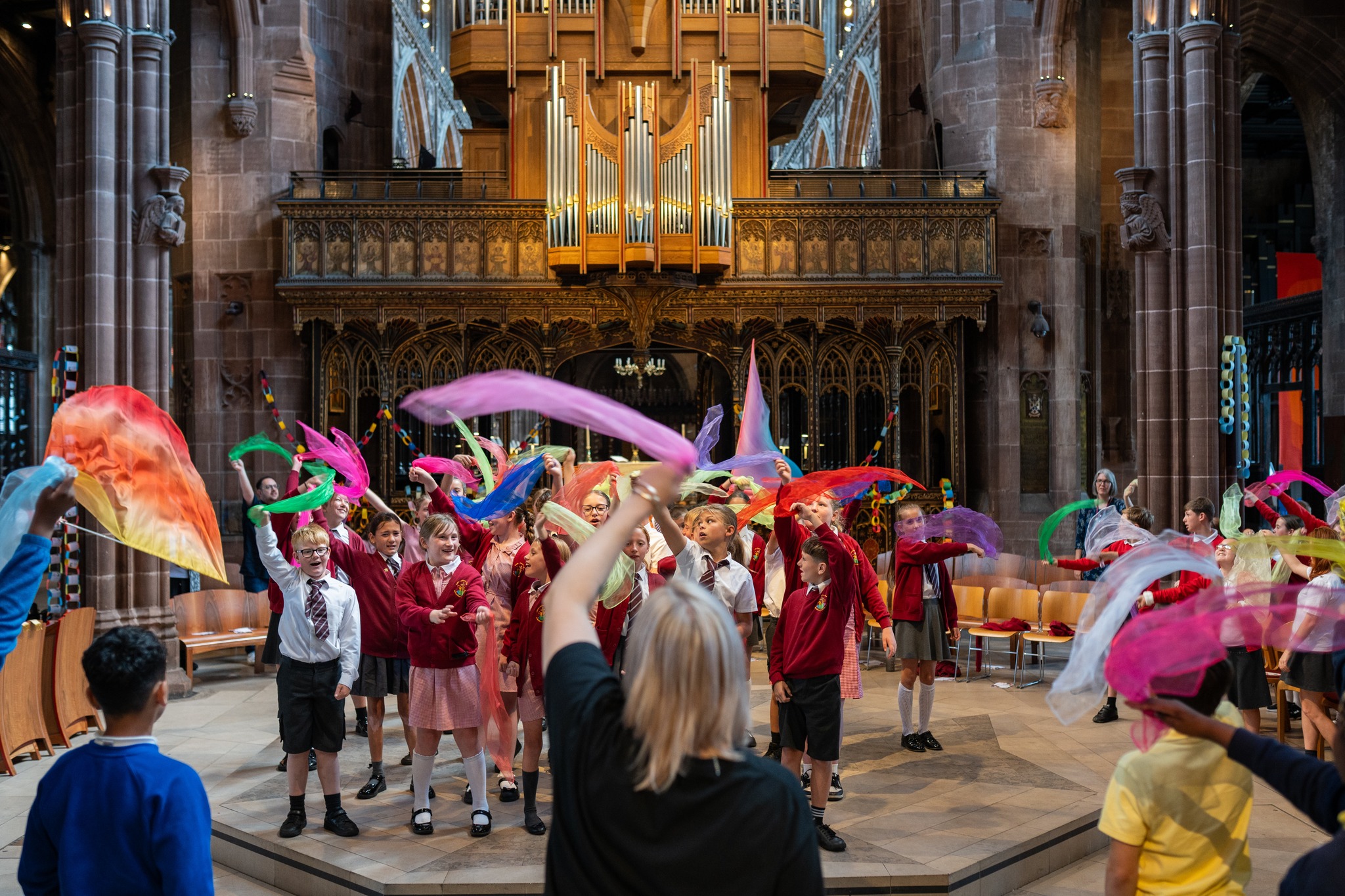
The Cathedral is working church with a living Christian community which welcomes all faiths and none. Our school tours are open to ALL schools, not just faith schools.
We strongly believe that every child and young person across Greater Manchester should feel that Manchester Cathedral is their Cathedral.
Whether visitors are from our region or further afield, Manchester Cathedral is the place to spark curiosity, imagination and inspire future generations.
What’s on offer for schools?
School tours are usually available on either Tuesday or Thursday mornings from 10:30am. We are able to offer a pre-bookable welcome and informal guided tour covering Christian beliefs, history, art and architecture that last approximately one hour.
With the help of the Manchester’s Diocesan Board of Education, we now offer resources that enhance the Key Stage 2 curriculum, with pre-visit activities, as well as suggested activities for during your visit. You can download the resource here.
Some years ago, we worked with the Universities of Manchester and Nottingham on a project called Faith in the Town. You may also find this resource useful which can be downloaded here.
As we are an Eco Cathedral, we have pledged to reduce the amount of paper we use so if you prefer to have printed resources, please arrange this yourself before your visit.
How do I book?
The Cathedral hosts hundreds of functions annually and it is essential to contact the Cathedral Office by email for available dates before visiting. Please book early to avoid disappointment.
To enquire about your booking please contact the Cathedral Office by emailing office@manchestercathedral.org and provide the following information:
1. The proposed date(s) and arrival/departure times of your visit. Please note: we are closed to visiting groups between 1pm to 2pm daily for the Eucharist service.
2. The total number of pupils and those accompanying.
3. The names of those individuals chaperoning the students.
4. The age group and Key Stage of the pupils.
5. Your direct contact details should we need to amend or cancel your booking.
6. Please let us know if you have any specific areas of interest that you would like to know more about, as this information will help our Guides during your tour.
Risk assessments and safeguarding
Our volunteer guides are required to pass an Enhanced DBS check and have up-to-date safeguarding training.
However, producing a risk assessment and ensuring the safeguarding of children during your visit is your responsibility.
Teachers and helpers should lead their group and stay with them at all times. During the visit, teachers will be responsible for the control and supervision of their group. No pupils are to be left unsupervised in any area at any time. We also ask that, due to being a place of prayer and worship, that pupils do not enter the chapels when in use.
We’ve put together some things to consider when preparing your risk assessment and for your visit which you can download here.
How much does it cost?
If you are a school visiting from within the Greater Manchester area, we suggest a donation of £3 per student for the maintenance of the Cathedral. Where schools are visiting us from outside of Greater Manchester, please be advised that a charge of £3 per student applies.
Donations can be made online prior to your visit (please let our office know your payment reference number along with your school name) or can be made by a cheque made payable to Manchester Cathedral.
If you’re visiting with a larger group or you’d like to guarantee a dedicated guide will be available for your visit, you can book in advance for a small fee.
How much does they cost?
Private guided tours are charged at £6 per adult.
We allocate one guide for every ten visitors.
When are private guided tours available?
Monday - Friday between 10:30am - 3pm.
Weekend tours may be available subject to availability.
How long do they last?
Tours last approximately one hour.
How do I book?
I f you’d like to enquire about booking a private guided tour, email office@manchestercathedral.org with your preferred date and the size of your party.
Please note, we require at least two week’s notice to confirm guide availability.
I don’t want to pay - can I still tour the Cathedral?
Manchester Cathedral is open to visitors from 9.30am - 4pm Monday to Saturday, and 12 - 4pm Sunday.
Our guides offer free tours for individuals from Monday to Saturday between 10am - 4pm.
As our guides are volunteers we cannot always guarantee their availability or if they will be busy when you arrive.
If you are a larger party or want to guarantee a tour, the best way to do this is pre-book in advance following the instructions above.
*Where visitors utilise guides from outside of the Cathedral for private tours, please be aware that a charge of £6.00 per-person will apply. For further information/details of how to arrange please email: office@manchestercathedral.org
The Hanging Bridge is a medieval bridge spanning the Hanging Ditch, which connected the rivers Irk and Irwell in Manchester England
For many years, the bridge was completely hidden, remembered only in the name of the area where it had stood, until its rediscovery and subsequent excavation as a result of demolition work carried out in the 1880s.
At that time, the bridge was opened to the public and in three months had about 32,000 paying visitors. It was then covered up during the Victorian expansion of Manchester. More than 100 years later it was rediscovered, and following restoration work went on display in 2002 as a main attraction of Manchester Cathedral’s newly built Visitor Centre.
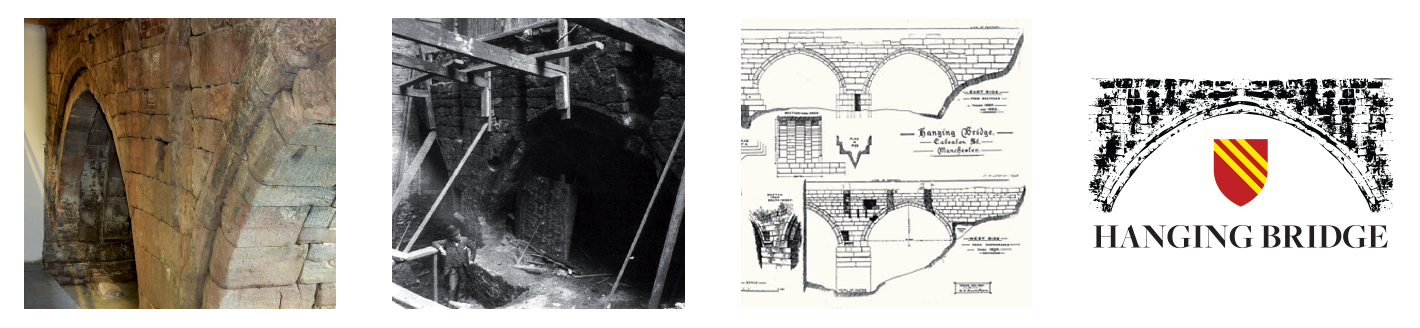
Today the bridge is largely hidden by modern buildings, but it can be seen in the basement of Manchester Cathedral Visitor Centre. The bridge is listed as a Scheduled Ancient Monument.
The earliest reference to a bridge dates from 1343, when it was called Hengand Brigge, but the present structure was built in 1421. Material taken from Manchester’s Roman fort may have been used in its construction. It has been speculated that the Hanging Ditch may be of Roman origin, part of a defensive circuit between the rivers Irk and Irwell.
At the River Irwell end, the Hanging Ditch was 120 feet (37m) wide and 40 feet (12m) deep. A stream flowed through the ditch, from the Irk to the Irwell – possibly the lost River Dene, which gave its name to Deansgate. The bridge has two arches and was built using sandstone from Collyhurst. It is 108 feet (33m) long and 9 feet (2.7m) wide. Hanging Bridge formed part of Manchester’s medieval defences, when it was the main route from Manchester to the Cathedral, then a Collegiate church.
In 1600 the Hanging Ditch was condemned as an unsanitary open sewer, and in the following years the ditch was culverted and the bridge buried and built over. A directory published in 1772 recorded that nine houses had been built along the line of the bridge, suggesting that it may have been covered over during the ?rst phase of Manchester’s town planning, sometime in the 1770s.
In April 2012, Volition Community the volunteer programme was launched by Manchester Cathedral. Starting with just 15 volunteers the programme quickly gained momentum and within our first two years over 100 people had gained a job with our support. Now we have twice as many volunteers each year than when we started and more than 1,100 volunteers have taken part. Volunteers from earlier groups are still around to support and mentor new groups coming in, inspiring them to grasp the opportunity with both hands and achieve their full potential.
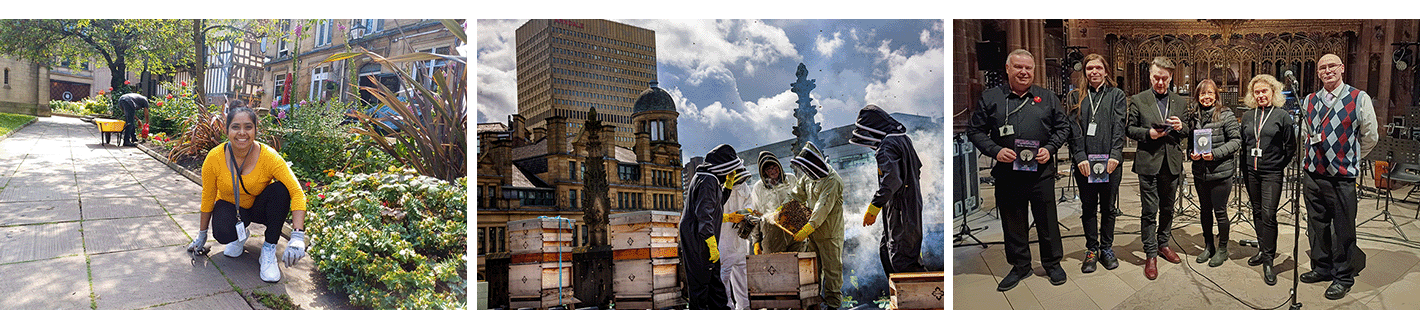
How does Volition work? We identify volunteer roles for unemployed people in partnership with Jobcentre Plus. At the same time we bring a sharp focus to their employability and skills needs, and create a structured pathway to support them back to work. Crucially, we engage employers as partners. Inherent in all we do are some key values, the things we believe in and include in everything we do.
There’s a wide variety of roles available and volunteers are matched to a role to give them the skills and experience needed to secure employment. We offer opportunities in: Welcoming, Guiding, Bee Keeping, Administration, Caretaking, Events and Gardening.